The rifts, and the Rift
The fold is instant. The getting there is not.
The rifts are the lanes
They are natural folds in space that link star to star. Nobody knows who or what made them, or whether anyone did. They are why the stars are open at all. Tau Ceti is twelve light-years from the old world and Deneb is two and a half thousand, and through the rifts they are the same day's work. Distance stopped mattering the day the lanes were found.
How a hop works
The fold is instant. The getting there is not. Every lane has a mouth, out past a star's planets. A hop is three parts:
- The run out. Sublight, from the dock to the mouth. Long and dull: the radio and the clock.
- The drop. Into the fold. Instruments say it takes no time at all. Pilots call the moment inside it the hang: total silence, which some swear is longer every time.
- The run in. Out of the far mouth and sublight again, until the lights of the port come up.
The further a lane reaches, the further out its mouth lies. From Tau Ceti, the mouth for the short lane to Pollux sits just past the planets. The mouth for Deneb is a long run out into the dark. So the chart is drawn in hours, not light-years, and two stars side by side on it are close in lane-time, whatever the real sky says. Pilots say "the map's a timetable" and "a long lane opens a long way out."
A faster ship reaches the mouth sooner. The fold itself costs nothing: fuel burns on the run.
The slack
The rifts are not single threads. They are a fold, like a sheet doubled over, and the space between the mouths is the slack: folded space a pilot can drop out into partway, if they know where they are going (dropping short). The slack catches things, as an eddy catches leaves. Comets drift there, wrecks end up there and Rift Glass collects there. Open space on the chart is the slack.
The slack is quiet. Comms relay through buoys at the mouths. Out in the slack, Dispatch's voice arrives on the delay, a few seconds late, then more. You are never quite out of earshot; the slack is where the "quite" lives.
Running the dark
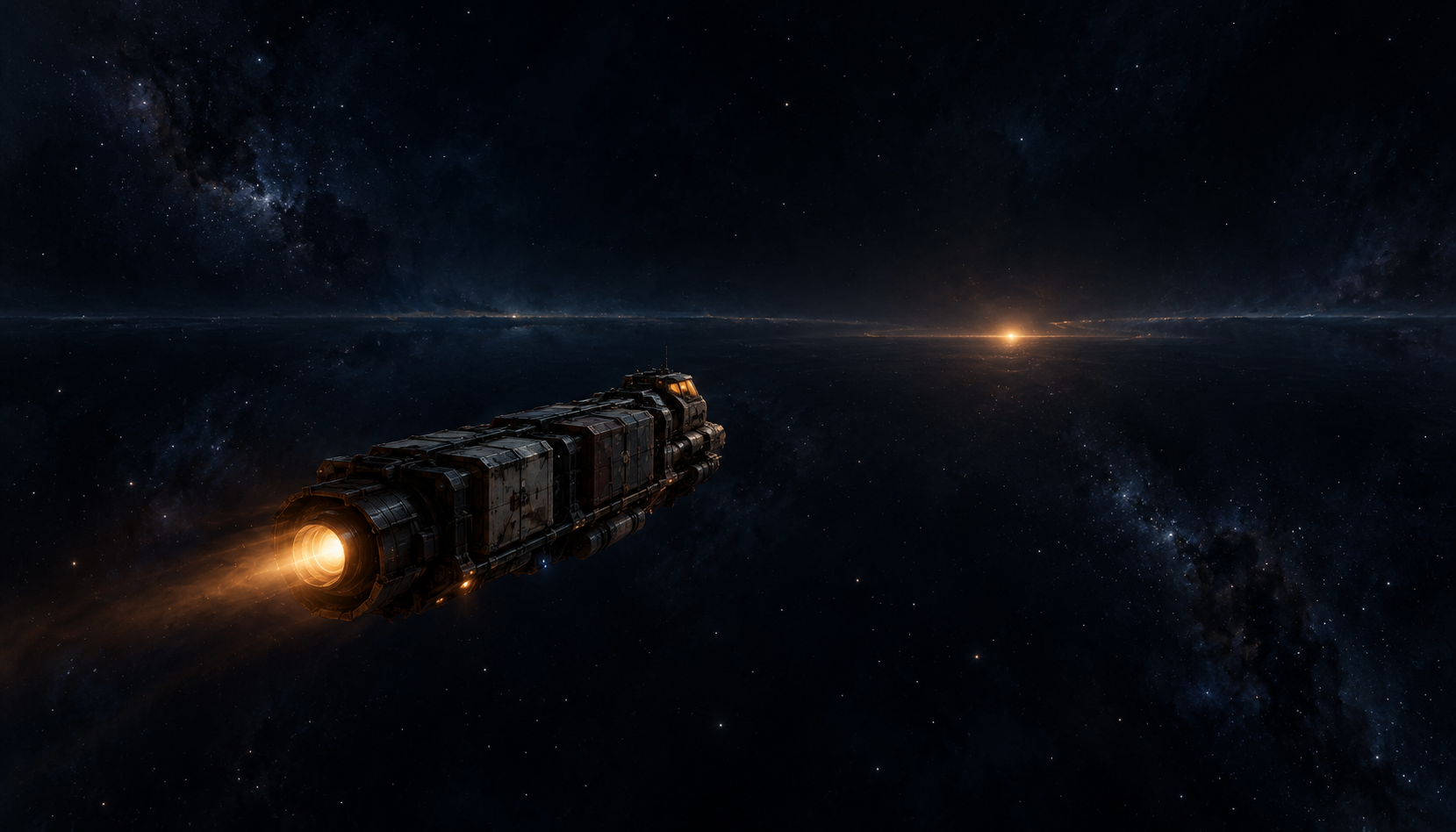
Not every mark sits along a lane. Some lie out past the edge of the chart, toward the Rift, where no lane goes. To reach them a pilot runs the dark: a long sublight run with no lane under them, slow, hungry on fuel, with Dispatch on a longer and longer delay. There is no dock at a mark, so nobody can refuel there. Running dry in the dark is what slack pilots fear most and the one thing they never joke about. Dispatch's emergency tab is the line home, and a pilot who needed it is talked about for years.
Rift-sick
Some people cannot take the drop: nausea, the shakes, a dread that lasts a day. Most pilots get over it in their first year. The ones who never had it at all are thought, quietly, to be a bit odd.
The Rift
The Rift (capital R) is where every lane converges. It is a vast, luminous fracture beyond charted space, and from the outer systems it shows as a seam of light across the sky. It is beautiful and it is dangerous.
It lies in no direction. Follow any lane rimward far enough, from any edge of the chart, and the lanes bend toward it. Charted space is an island, and the Rift is the sea all round it. From Deneb you see it. From Gienah, on the far side of the chart, you see it too, and it looks no further off. (Coreward is the other way: in, toward the registry worlds.)
Pilots say the Rift in front of strangers. Among themselves: the Seam, the Glare, and on a bad night, Her. Nobody agrees who started calling it Her.
What it does: - It glares. Near it, instruments wash out. Pirates hide in the glare, and the Reavers come out of it. The nearer the Rift, the stranger the trouble. - It storms. A glare-storm rolls inward along the lanes. Lanes close while it passes, and ships sit at the mouths and wait. - It gives things up. Rift Glass, hulks nobody can identify, anomalies that drift inward and fade. - It takes things back. Ships that went too close. This is the dread under the awe. - It is not on the map, and it is never docked at. It is felt, seen in the sky and talked about.